
200-Amp Panel and Service Upgrade: A Typical Davenport Project
A Davenport house built in the middle of the last century is often still fed by a 60- or 100-amp service sized for a furnace, a range and a few lamps. Taking it to 200 amps means replacing the meter socket, the service entrance conductors and the panel itself, not just swapping breakers. This walkthrough covers how that job usually runs, from the permit to the moment the meter is set again.
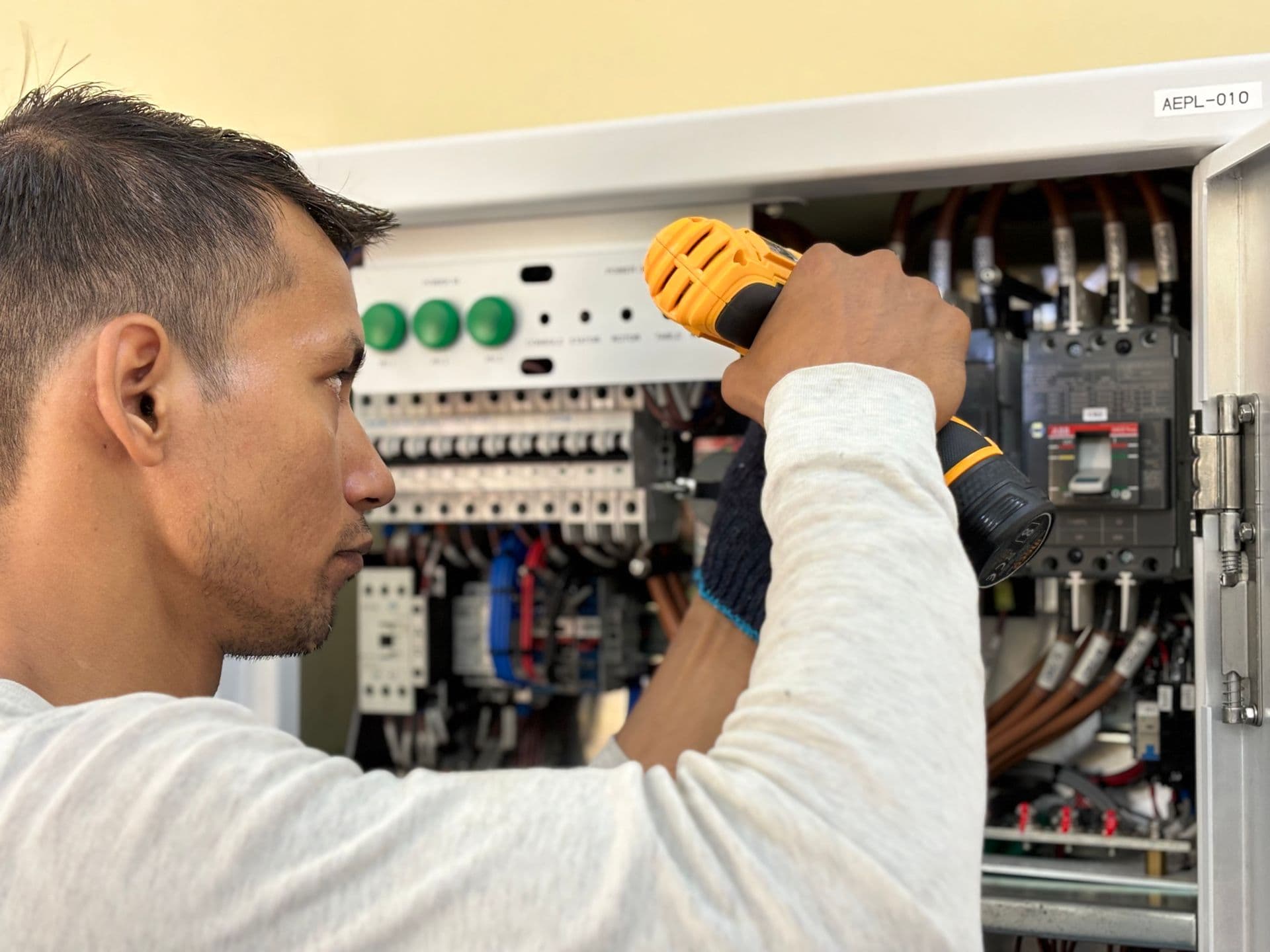
This is a walkthrough of a typical project of this kind, not a specific customer’s job. Your own scope is confirmed on site before any work starts.
What this job covers
The work covers everything from the point the utility drop or lateral reaches the house inward: the meter socket, the service entrance conductors, the mast or riser where one is used, the main disconnect, the new panel and the grounding electrode system. Branch circuits are transferred one at a time onto new breakers, tested and labelled.
- A 200-amp panel with spare spaces, so the next circuit does not need a tandem breaker or a second board
- A new meter socket and service entrance conductors rated for the full service, not for what is there now
- Grounding and bonding brought up to current NEC requirements, including the water line and any ground rods
- AFCI and GFCI protection where the code now calls for it on the circuits being landed
- A legible directory, so every breaker is identified after we leave
How the work runs
- Load and condition checkWe look at what the house actually draws, what the existing service can carry, and the state of the entrance cable, the socket and the grounds. That is what decides whether this is a panel swap or a full service upgrade.
- Permit and utility coordinationDavenport lists improvements to a property’s electrical system among the work that requires a permit, and states that contractors take the permit out on behalf of the owner. We file it and book the utility disconnect together, because the two have to line up on the same morning.
- Power off, old gear outWith the service disconnected at the meter, the old panel and entrance cable come off the wall. This is the part a household feels: the house is without power for most of the working day, so the refrigerator and anything medical get planned for in advance.
- New entrance and panel setThe meter socket, entrance conductors and panel go in, then the grounding and bonding. The panel is set where an inspector today and an electrician in twenty years can both reach it and work in front of it.
- Circuits transferred and labelledEach branch circuit is landed on its own breaker with the protection the code requires, tested, and written into the directory. Anything found damaged or unsafe during the transfer is raised then, not quietly reconnected.
- Inspection, then reconnectThe city inspects the finished service, and only then does the utility reset the meter and energise it. We are on site for both, because a question at either visit is faster answered than rescheduled.
Things that move the scope
Two things shape this job more than anything technical. The city requires a licensed contractor to take the permit out, and Public Works notes that the service drop and the meter belong to MidAmerican Energy, so everything from the meter inward is ours to repair. That boundary sets the schedule, because the utility has to be there to pull the meter and there again to reset it.
- An entrance run up an exterior wall may need a new mast, which turns a one-day job into one that waits on weather
- Aluminium branch conductors found in the old panel are pigtailed with listed connectors rather than landed straight on new breakers
- A finished basement ceiling under the panel adds hours, because feeders and grounds have to be routed without opening it up
- Ungrounded or knob-and-tube circuits found during the transfer are a separate conversation: a new panel does not make an old circuit grounded
A 200-amp service is not automatically the right answer. If the load calculation says a smaller service carries the house with room to grow, that is what we fit, and we say so before anything is ordered.
Panel & Service Upgrades questions
Plan on most of a working day. The utility pulls the meter in the morning and does not reset it until the city has inspected the new service, so the house is without power in between.
No. The upgrade replaces the service and the panel, and the existing branch circuits are transferred onto it. Circuits that are unsafe in their own right are identified during the transfer and handled separately.
We do. The city states that contractors are required to take the permit out on behalf of the property owner, and we file it as the licensed contractor before the work is scheduled.
Sometimes, when the trips come from an overloaded service. If the fault sits on the circuit itself, a new panel only gives a healthy breaker a bad circuit to protect, so we trace it first.
This walkthrough is one example of Panel & Service Upgrades across the Quad Cities, and of the electrical work we do in Davenport, IA. More walkthroughs are on the projects index.
Need panel & service upgrades in Davenport?
24-hour emergency service available